Friday, May 03, 2013

Casting Call for Heels Of Glory, A Drag Action Musical


Auditions

'Heels Of Glory': A Drag Action Musical by Tricity Vogue & Richard Link


Heels of Glory is an original musical with an action movie plot, a ’60s comic book aesthetic, and the kind of tunes that would have graced a vintage James Bond movie — if they’d ever made one with song-and-dance numbers and a drag queen spy.

The Artistic Team:

The show is written by composer Richard Link (Two Blondes With A Passion, Watch Me Shine, A Little Princess) and cabaret performer Tricity Vogue AKA award-winning screenwriter Heather Tyrrell (Byker Grove, My Family, Totally Frank).

Direction & Choreography will be by Russell Lucas (Julie Madly Deeply, Goldsmiths New Musical Festival)

Heels Of Glory will be staged at The Albany Theatre, Deptford on Friday 5 July 2013. We have secured research and development space at the theatre for six days prior to the scratch performance which is when we will explore, direct and choreograph the show. An intense few days - not for the faint-hearted!

This is the third version of the musical, following a rehearsed reading in April 2012 and a sold out work-in-progress performance at the Royal Vauxhall Tavern in January 2013. Please note that at this stage everyone will be working for free but a professional approach to the work is paramount. This will be an incredible opportunity for networking though, building experience and being part of an exciting fast paced week, plus the chance to add to the genesis of an innovative piece of musical theatre.

Cast requirements:

We are looking for three “triple threat” drag queens, a “triple threat” diva plus two “triple threat” drag kings.

You do not have to have been a drag queen/king at any point. We are seeking confident performers who will be versatile enough to play anything we throw at them.

Character names and minimum requirements:

- Splendorella. International drag queen superstar (and spy). High baritone singer with star quality. A first class bitch.
- Allura. Creative Director of Supreme Cosmetics, every drag queen’s go-to brand (and evil villainess plotting the annihilation of all drag queens). Singer with strong belt and a heart of pure evil.
- Honey. A drag queen wannabe and Splendorella super-fan. A baritone singer, and a baby bitch with upstart attitude.
- Jay. Honey’s best friend. A vintage James Bond geek and reluctant drag queen. A tenor singer and an innocent with hidden talents.
- Albertina. Allura’s henchman, hit man, barman, backing dancer, bodyguard, and thwarted showgirl.
- Bertilda. Allura’s henchman, hit man, barman, backing dancer, bodyguard, and thwarted showgirl.

Auditions

Auditions will be held on Friday 10 and Saturday 11 May, at a pre-allocated time between 10am and 5.30pm. Venue TBC. These will be workshop style auditions.

When you have sent through your details we will contact you to let you know if you have got through to a workshop audition.

Call backs will be held on Sunday 12 May - time TBC.

Please note that your audition will last 90 minutes and you will be in groups of eight. Although you will perform solo, sometimes other actors will be in the room. We are looking to create a company of artists that are open and supportive and wish to encourage a safe, risk-free environment from the outset. The artistic team will also be leading exercises, games and giving you specific direction.

Material

We ask that actresses bring a song from the 60's and actors bring a song for a female voice from the 60s.

Please also bring a prepared piece of text that you may need to use in the workshop. This can be from theatre, films, poems, books - anything that you love!

Rehearsal dates:

Thu 27 June, Fri 28 June, Mon 1 July, Tue 2 July, Wed 3 July.

Time: 10am to 6pm

Performance is 5th July

The whole company will be needed from 10am to 9pm.

All rehearsals and the performance will take place at The Albany Theatre, Deptford (Deptford or New Cross station, zone 2)

If this sounds like you then we would love to hear from you. Please send a Headshot of yourself a CV or Spotlight number and a one-page covering letter telling us all about you to auditions@heelsofglory.com

Application deadline is Monday 6 May by 12 noon.


Poster art by Steve May

Friday, December 07, 2012

How The Blue Lady Became - A Fairy Tale

Once upon a time a princess lived in a castle in a cold mountain land. The castle was very warm inside, but the princess longed to explore the beautiful mountains, even though everyone in the castle told her she would freeze to death if she went outside, as her mother the queen had done when she left the castle with a mysterious traveller one night so many years before. Yet every day, the princess would sit in the window of her tower and look at the long empty road that led away through the mountains into the lands beyond, and sing a song of longing.

One day as the princess was gazing out at the long road through the mountains, and singing her song of longing, she saw a traveller walking towards the castle. He sat under her window and listened to her song. Then, when she stopped singing, he went away. The princess was sad. The next day when she came to her window and began to sing her song of longing again, the traveller returned, and sat listening to her song. On the third day the same thing happened. But on the fourth day when the princess sang nobody came. Sad, she went down to the banqueting hall for the feast, only to find the traveller warming his hands by the hearth. Her father the king told her that he had found the traveller outside the castle walls while out hunting, and offered him a meal and a warm bed for the night.

The princess sat beside the traveller all night, listening to his tales of the lands over the mountains. The traveller was on his way to a magical island in a deep blue ocean, where it was always warm and where beautiful flowers grew, and every tree was heavy with fruit. The princess had never seen flowers or trees, or the ocean, and she longed to go with him. “Why don’t you?” asked the traveller. But the princess told him sadly that if she ever went outside the castle, she would freeze to death. “Oh no you won’t,” said the traveller, and told her he had a gift for her that would stop her from freezing. He showed her a beautiful fur coat. The princess tried it on and felt warm from head to toe. “What can I give you in exchange?” she asked the traveller. “Sing me a song,” he said. So she did. And that night, when everyone in the castle was fast asleep, she put on her new fur coat, and followed the traveller out of the castle and onto the long empty road. But in her fur coat she didn’t freeze. She didn’t feel the cold at all.

The princess and the traveller walked for many days and many nights, all the way through the mountains to the other side. Every day the princess saw marvellous things she never new existed, and every night she sang to the traveller as he built them a fire and cooked the food he had foraged and hunted along the road. Eventually they reached a deep dark forest and the princess was frightened, but the traveller held her hand and promised to keep her safe. As they walked through the forest they heard the crackle of branches as something came towards them. The traveller unsheathed his knife, but it was only an old lady in a long travelling cloak and hood. “I am all alone and the forest is a dangerous place,” she said. “Please may I travel with you?” But the traveller told the old lady to keep away and leave them alone. The princess was sad, but the traveller said he could only look after one other person, and the old lady would slow them down. He wanted to get to the magical island as quickly as he could.

As they travelled on, the forest got warmer and warmer, and became a jungle, and the princess became very hot in her fur coat. But the traveller wouldn’t let her leave it behind, because it was too precious, and one day she would want to return to her mountain homeland, and then she would need the coat again. So the princess struggled on, carrying the coat under her arm, but it became a heavier and heavier burden. One night as the traveller slept, the princess was woken by the sound of weeping. She followed the sound and found the old lady sitting crying in a small clearing nearby. The princess thought the old lady was crying because she had no food, so brought her some of the stew from their own stewpot. But the old lady said the real reason she was crying was because she was lonely. The princess felt ashamed that the traveller had turned the old lady away, and told her to travel with them to the magic warm island. But the old lady said she did not want to go to the magic warm island, she was tired of the heat. She wanted to go back to the beautiful icy mountains where she came from, but she was so old and so frail that she would freeze to death on the road before she ever reached the castle. So the princess gave the old lady her fur coat. The old lady thanked her for her kindness, with tears in her eyes. The princess slept soundly that night. The next morning she told the traveller nothing of what had happened the night before.

The next day the traveller and the princess reached the edge of the jungle and walked out onto a beach of golden sand. In front of them was a deep blue ocean, and rising out of the ocean was the magic island. They could just see tiny people waving to them on the shore. Eagerly the traveller threw off his clothes and waded into the water, ready to swim across. He held out his hand to the princess. But the princess would not follow him into the water. She had never seen water before and she was afraid. She could not swim. The traveller was impatient to reach the magic island, but he offered to teach the princess how to swim so she could come with him. The princess was afraid, but she followed the traveller into the water, because she had followed him all the way from her frozen homeland and he had kept her safe until then. The traveller held the princess up in the water and showed her how to move her arms and legs, but as soon as she let go she would sink under the water, again and again, and the traveller would have to pull her back to the surface, choking and gasping. All day he tried to teach her, until the princess was so tired and afraid of the water that she could bear no more. So the traveller helped her back to the shore, where she sat shivering on the beach, despite the heat. “Put on your fur coat and warm yourself,” said the traveller. But the princess told him she no longer had the fur coat, because she had given it to the old lady. Then the traveller was very angry. This is why he had sent the old lady away, because she was a trickster and a thief. The princess had concealed from the traveller that the old lady was following them, and the old lady had taken the most precious possession that the foolish, trusting princess owned. If the princess did not trust the traveller to look after her, and did not follow his lead, then he would not help her to reach the magic island. With that, the traveller dived into the sea, swimming to the magic island and leaving the princess behind.

The princess sat on the beach alone, watching the traveller swim away from her, while the tears ran down her cheeks. She sang again the song of longing she had sung before from the window of her castle room as she looked out over the long empty road into the mountains. Then the old lady came to her again, and wrapped the fur coat around the princess’s shoulders to stop her shivering. “Do you really want to reach the magic island?” asked the old lady. “More than anything in the world,” replied the princess. “Then,” said the old lady, “because you have given me a gift, I will give you a gift.” And the old lady gave the princess a jar of blue paste. “This paste is made from the shells of the creatures that live on the ocean floor,” she said. “I have been collecting them for many years, and for many years I have been crushing the shells to paste with my pestle and mortar, but now I have enough, I no longer want to reach the magic island.” “But what does the paste do?” asked the princess. “Cover your whole body with the paste,” said the old lady, “every inch of it. And the blue will protect you, so that you can walk right under the waves and into the water, without drowning.” “Oh thank you!” said the princess, reaching for the paste. But before the old lady would give the paste to the princess she had one more warning. “Once you have covered yourself with this paste, it will never wash off again. You will always be blue.” “What do I care what colour I am,” said the princess, “as long as I can get to the place I long to be more than anywhere else in the world?” So the old lady gave the princess the blue paste, and the princess gave the old lady back her fur coat once more, because now she was filled with hope again she had stopped shivering, and the two women said goodbye.

The princess covered herself in the blue paste from head to toe, and then she walked into the water. Sure enough, as soon as the waves closed over her head, the princess discovered she could still breathe, and she could see everything under the water too. The princess walked along the seabed towards the magic island, and along the way she travelled through the most beautiful world she had ever seen, full of sea anemones and brightly coloured fish. When she reached the island she walked out of the ocean onto the beach, and there, sitting on the shore, was the traveller. He was staring across the ocean to the beach where he had left her, and there were tears pouring down his cheeks. The princess walked over to the traveller. “It’s all right, I’m here,” she said. But when the traveller saw her he leapt away from her in horror. “It’s me,” she said, “the princess!” But the traveller said, “Get away from me, monster!” He did not recognise the princess. The princess thought of a way to show the traveller it was her, so she began to sing. But the traveller put his fingers in his ears. “Stop that ugly sound!” he shouted. “And get away from me!”

Heartbroken, the blue princess walked away from the traveller, through the flowers and the fruit trees of the magic island. But she didn’t see them, because her eyes were full of tears. The blue princess climbed to the top of a rock by the water and she sang her song of longing, as the tears fell down her face. But although the tears trickled down her skin, they didn’t wash off the blue, because the blue was there forever. The blue princess didn’t even try to rub the blue away, because she knew the old lady had been telling the truth. She would always be blue now. It was only when the sun had set and the princess climbed down from her rock that she discovered a crowd of island people gathered at the foot of the rock, all on their knees before her, and offering up trays laden with fruit and garlands of flowers. As she walked among them they lifted her up on their shoulders and hailed her as their blue goddess, who came to them from the ocean and healed their pain with her song.

The island people carried the princess to a beautiful garden palace full of flowers and fountains, music and joy, where everyone danced and laughed and feasted, and where she lived happily among them for many years. But sometimes the princess would dream about the frozen mountain land of her childhood, and as the years went by she began to long to return there. So sometimes the blue goddess would walk alone into the waves and gather tiny blue sea creatures from the ocean floor, then she would carry them back to her palace and crush the shells into a paste, until, after many years, she had a whole jar full of blue paste. Then she said goodbye to her people and walked into the waves, never to return.

When she reached the other shore, the blue princess concealed the colour of her skin beneath a cloak and hood, and walked into the forest. After a few days travel she met a man and a young woman travelling together. The man did not trust her and sent her away, but the woman was kind to her and offered her food, so the blue princess followed them, keeping out of sight. One night the blue princess found the woman crying by herself in a clearing. She asked her what was wrong and the young woman said that she wanted to reach the magic island, but she couldn’t swim. The blue princess offered the woman her jar of blue paste, and the young woman accepted it gratefully. In exchange she offered the blue princess her fur coat, so the blue princess could travel to the frozen mountains. Before the blue princess left the young woman she warned her that once she had covered herself in the blue paste, although she would be able to walk under water without drowning, she would be blue forever, and her companion might reject her. But the young woman smiled. “When you are a traveller,” she said, “everywhere you go and everyone you meet is strange and foreign. So you must accept them all. Or you will always be alone.”

So the blue princess put on the young woman’s fur coat and walked towards her frozen mountain home, knowing that her island people would soon meet their new blue goddess from the waves, and that waiting for her in a warm mountain castle far away was the old lady who had helped her so many years before, and who was also the blue queen, her mother.

Sunday, July 29, 2012

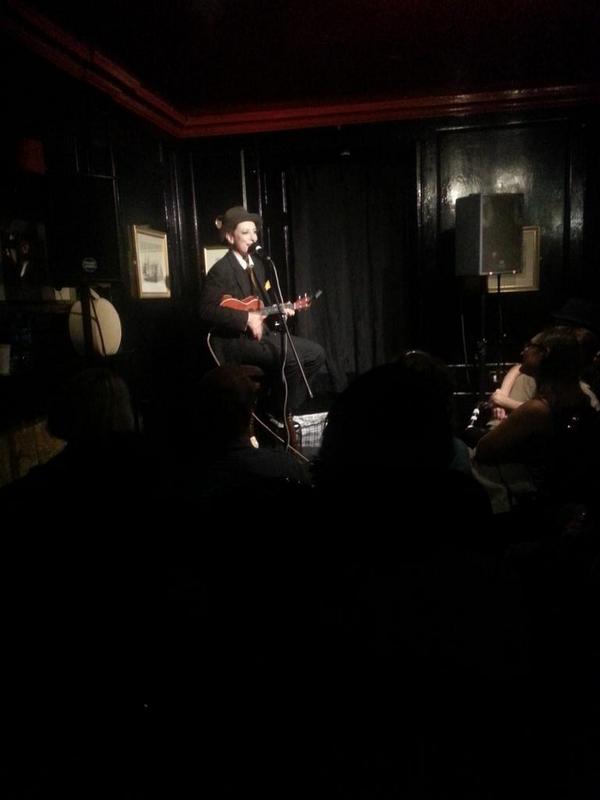
Tricity Vogue's Ukulele Cabaret - Edinburgh Fringe 2012

TRICITY VOGUE'S UKULELE CABARET returned to the Edinburgh Fringe for its third year in 2012 - 9.30-10.30pm nightly in the Ballroom of Laughing Horse @ The Counting House, from 2nd to 26th August. A star-studded line-up of special guests battled to win the coveted Uke of Edinburgh Award. Each winner chose a topic for Tricity to write a song about for the next show.

You can listen to Tricity's songs on Soundcloud here.

LINE UP DETAILS BELOW:

Thursday 2 August
Desmond O'Connor, Ria Lina, Dusty Limits
Uke Of Edinburgh Award Winner: Lins McRobie of Edinburgh Uke Hoot (audience contestant)
Tricity's song topic: Bowler Hat


Friday 3 August
Dusty Limits, Audacity Chutzpah, Miranda Kane
Uke Of Edinburgh Award Winner: Audacity Chutzpah
Tricity's song topic: Goats


Saturday 4 August
Ben Jones, DeAnne Smith, Emily Scott, The Stillhouse Orchestra
Uke Of Edinburgh Award Winners: Ben Jones and DeAnne Smith
Tricity's song topic: Aubergine


Sunday 5 August
Eleanor Morton, Katrina Smith. Bob and Jim, Albert Spink
Uke Of Edinburgh Award Winner: Eleanor Morton
Tricity's song topic: Mothballs


Monday 6 August
Ria Lina, Stav Meishar, Myra Dubois, Eleanor Morton
Uke Of Edinburgh Award Winner: Ria Lina
Tricity's song topic: Awards


Tuesday 7 August
Sarah-Louise Young, Billy Wagg (Susan Harrison), Howard Read, Molly Beth White
Uke Of Edinburgh Award Winners: Billy Wagg and Sarah-Louise Young
Tricity's song topic: A happy song about the death of a pet


Wednesday 8 August
Joby Mageean, Audacity Chutzpah, Josh Richards, Amelia Robinson
Uke Of Edinburgh Award Winners: Joby Mageean and Audacity Chutzpah
Tricity's song topic: Nintendo Wii (with actions)


Thursday 9 August
Ria Lina, Jane Bom-Bane, Robert Inston, Jax Braithwaite
Uke Of Edinburgh Award Winner: Jax Braithwaite
Tricity's song topic: Alliteration...and Fanny


Friday 10 August
Helen Arney, Mark Wallington, Molly and Me, Gareth and Misha
Uke Of Edinburgh Award Winner: Molly and Me
Tricity's song topic: Sunglasses


Saturday 11 August
Lady Carol, Mark Wallington, Ashley Frieze, Sophie Steel
Uke Of Edinburgh Award Winner: Lady Carol
Tricity's song topic: Mental Block


Sunday 12 August
Jo Stephenson, Eleanor Morton, Mat Ricardo, Uke Gnome
Uke Of Edinburgh Award Winner: Eleanor Morton
Tricity's song topic: Lady Pirates


Monday 13 August
Tim Clare, Jess Guille, Uke Gnome, Formby (Ewan Wardrop)
Uke Of Edinburgh Award Winner: Formby
Tricity's song topic: Bells


Tuesday 14 August
She Makes War, Roland Dootsan, Gareth Ellis, Leela Bunce
Uke Of Edinburgh Award Winner: Leela Bunce
Tricity's song topic: Harry Potter


Wednesday 15 August
Jonny Woo, Josephine Shaker, Callum Scott, Dan Woods, Mr Mistress
Uke Of Edinburgh Award Winner: Mr Mistress
Tricity's song topic: My Drag Queen Wet Dream


Thursday 16 August
Ria Lina, Sh!t theatre, Peter Buckle, Desmond O'Connor
Uke Of Edinburgh Award Winner: Sh!t theatre
Tricity's song topic: Funemployment


Friday 17 August
Helen Arney, Ben Jones, Owen Niblock, Amie Amis
Uke Of Edinburgh Award Winner: Amie Amis
Tricity's song topic: Pineapple


Saturday 18 August
Holly Penfield, Dan Woods, DeAnne Smith, Bob Slayer
Uke Of Edinburgh Award Winner: Dan Woods
Tricity's song topic: 29 Espressos


Sunday 19 August
The Curious Couple From Coney, Tom Harlow, Rosy Rebel, Mat Ricardo
Uke Of Edinburgh Award Winner: Tom Harlow
Tricity's song topic: Glitter


Monday 20 August
DeAnne Smith, Dave Bear, Joe Black, Mr B The Gentleman Rhymer
Uke Of Edinburgh Award Winner: DeAnne Smith
Tricity's song topic: Gentlemen


Tuesday 21 August
Jonny Woo, Bethany Singh, John Lane, David (Audience Member)
Uke Of Edinburgh Award Winner: Bethany Singh
Tricity's song topic: Paper Cranes


Wednesday 22 August
Johnny Suave (Chris Young), Dave Nelder, Josephine Shaker, Jamie Bowen
Uke Of Edinburgh Award Winner: Josephine Shaker
Tricity's song topic: Penguins Drinking Beer


Thursday 23 August
Ria Lina, Cera Impala, Michael Munnik, Jolly Boat, Tom McDermott
Uke Of Edinburgh Award Winner: Ria Lina
Tricity's song topic: Alternative Universes


Friday 24 August
Helen Arney, Molly & Me, Miranda Kane, Shit Theatre, Vanessa Hammick
Uke Of Edinburgh Award Winner: Helen Arney
Tricity's song topic: Beaker from the Muppets


Saturday 25 August
Lisa Kenny, Johnny Setlist, Ben Jones, Mervyn Stutter
Uke Of Edinburgh Award Winner: Mervyn Stutter
Tricity's song topic: Varifocals


Sunday 26 August
Gareth Ellis, Tricity Vogue, Ria Lina, Amie Amis, Josephine Shaker, Shit Theatre, Johnny Setlist, Ben Jones, Lins McRobie, David (Audience Member)

TRICITY VOGUE'S UKULELE CABARET
Laughing Horse @ The Counting House, Ballroom, 38 West Nicolson Street Edinburgh EH8 9DD
AUG 2-26, 2012 at 9.30-10.30pm
ENTRANCE FREE

Here's the show on the Fringe website.

Tricity also hosted a FREE PAINT AND PLAY UKULELE WORKSHOP every Saturday in August between 1pm and 3pm at Rae Macintosh Music shop. More details on the Fringe website.

Tuesday, February 14, 2012

Extracts from "An Incomplete Manifesto For Growth" by Bruce Mau

In 2004, while I was staying in Edinburgh, my friend Paul showed me an A4 photocopy of some advice for designers which I liked so much I copied extracts from it into my notebook.

I thought of it again just yesterday, while I was toiling over a cover version of a Tom Waits song, and decided to dig it out and have another look at it.

You might find some or all of these ideas interesting too:


1) ALLOW THINGS TO CHANGE YOU
Growth is different from something that happens to you. You produce it.

2) FORGET ABOUT GOOD

3) PROCESS IS MORE IMPORTANT THAN OUTCOME

4) LOVE YOUR EXPERIMENTS (AS YOU WOULD AN UGLY CHILD)
Joy is the engine of growth. Take the long view and allow yourself the fun of failure every day.

5) GO DEEP
The deeper you go, the more likely you are to discover something of value.

6) CAPTURE ACCIDENTS
The wrong answer is the right answer in search of a different question.

7) STUDY
Use the necessity of production as an excuse to study. Everyone will benefit.

8) DRIFT
Allow yourself to wander aimlessly. Explore adjacencies. Lack judgement. Postpone criticism.

9) BEGIN ANYWHERE
John Cage tells us that not knowing where to begin is a common form of paralysis. His advice: begin anywhere.

10) EVERYONE IS A LEADER
Growth happens. Whenever it does, allow it to emerge. Learn to follow when it makes sense. Let anyone lead.

11) HARVEST IDEAS. EDIT APPLICATIONS
Ideas need a dynamic, fluid and generous environment to sustain life. Applications, on the other hand, benefit from critical rigour. Produce a high ratio of ideas to applications.

120 KEEP MOVING
The market and its operations have a tendency to reinforce success. Resist it. Allow failure and migration to be part of your practice.

13) SLOW DOWN
Desynchronize from standard timeframes and surprising opportunities may present themselves.

14) DON'T BE COOL
Cool is conservative fear dressed in black. Free yourself from limits of this sort.

15) ASK STUPID QUESTIONS
Growth is fuelled by desire and innocence. Assess the answer, not the question. Imagine learning throughout your life at the rate of an infant.

16) COLLABORATE
The space between people working together is filled with conflict, friction, strife, exhilaration, delight, and vast creative potential.

17) _______________
Intentionally left blank. Allow space for the ideas you haven't had yet, and for the ideas of others.

18) STAY UP LATE
Strange things happen when you've gone too far, been up too long, worked too hard, and you're separated from the rest of the world.

19) WORK THE METAPHOR
Every object has the capacity to stand for something other than what is apparent. Work on what it stands for.

20) BE CAREFUL TO TAKE RISKS
Time is genetic. Today is the child of yesterday and the parent of tomorrow. The work you produce today will create your future.

4) REPEAT YOURSELF
If you like it do it again. If you don't like it, do it again.

22) MAKE YOUR OWN TOOLS
Tools amplify our capacities, so even a small tool can make a big difference.

23) STAND ON SOMEONE'S SHOULDERS
You can travel farther carried on the accomplishments of those who came before you. And the view is so much better.

24) AVOID SOFTWARE
Everyone has it.

25) DON'T CLEAN YOUR DESK
You might find something in the morning that you can't see tonight.

26) DON'T ENTER AWARD COMPETITIONS
Just don't. It's not good for you.

27) READ ONLY LEFT-HAND PAGES
Decrease the amount of information and leave room for your "noodle".

28) MAKE NEW WORDS
New conditions demand new ways of thinking, which demands new words, which generates new conditions.

29) THINK WITH YOUR MIND
Forget technology. Creativity is not device-dependent.

30) ORGANISATION = LIBERTY
The myth of a split between "creatives" and "suits" is what Leonard Cohen calls a "charming artifact of the past".

31) DON'T BORROW MONEY
By maintaining financial control, we maintain creative control.

32) LISTEN CAREFULLY
Every collaborator who enters our orbit brings a world more strange and complex than any we could ever hope to imagine. By listening to the details and the subtlety of their needs, desires or ambitions, we fold their world into our own. Neither party will ever be the same.

33) TAKE FIELD TRIPS
The bandwidth of the world is greater than that of your TV, or the internet, or even a totally immersive, interactive, dynamically rendered, object-oriented, real-time, computer graphic simulated environment.

34) MAKE MISTAKES FASTER

35) IMITATE
Don't be shy about it. Try to get as close as you can. You'll never get all the way, and the separation might be truly remarkable.

36) SCAT
When you forget the words, do what Ella did: make up something else... but not words.

37) BREAK IT, STRETCH IT, BEND IT, CRUSH IT, CRACK IT, FOLD IT

38) EXPLORE THE OTHER EDGE
Great liberty exists when we avoid trying to run with the pack. We can't find the leading edge because it's trampled underfoot. Try using old-tech equipment made obsolete by an economic cycle but still rich with potential.

39) COFFEE BREAKS, CAB RIDES, GREEN ROOMS
Real growth often happens outside of where we intend it to, in the interstitial spaces - what Dr Seuss calls "the waiting place".

40) AVOID FIELDS. JUMP FENCES
Disciplinary boundaries and regulatory regimes are attempts to control the wilding of creative life. It's our job to jump the fence.

41) LAUGH
Use it as a barometer of how comfortably we are expressing oruselves.

42) REMEMBER
Without memory, innovation is merely novelty.

43) POWER TO THE PEOPLE
Play can only happen when people feel they have control over their lives. We can't be free angents if we're not free.


Bruce Mau runs a Toronto and New York based design studio. The full manifesto is on his website here:
http://www.brucemaudesign.com/4817/112450/work/incomplete-manifesto-for-growth

But I thought it was more fun to copy out the bits I'd written down in my own notebook eight years ago. It looks like I jotted down most of it in the end, but then, according to point number 35, copying might be a good thing to do anyway.

TV
xx

Saturday, March 12, 2011

Tretchikoff and the Real Blue Lady


Cabaret singer Tricity Vogue finds the artist who inspired her hit Edinburgh show, and the woman who was his muse
This article was first published in the Erotic Review: The Art Issue in February 2011 http://www.eroticreviewmagazine.com/

On my bedroom wall is a 1960s framed print of a woman with a blue-green face, a golden Chinese gown, jet-black hair and startling red lips. I bought it on the Essex Road in North London from a shop called Past Caring. It cost me £70. My mum remembers when the same print sold in Boots the Chemist in Derby for 11 shillings and sixpence. She also remembers that it was the picture everyone wanted on their walls. The Chinese Girl was once better-selling than the Mona Lisa. Vladimir Tretchikoff, the painter, was compared to Picasso and Van Gogh: primarily by himself. The ubiquity of the image for over two decades was also primarily down to the artist himself, thanks to a combination of tireless self-promotion and bullet-proof self-belief. But then, when you’ve survived a revolution, a shipwreck and a Japanese prison-of-war camp, artistic world domination wouldn’t seem beyond you either.


I’ve spent two years painting my face blue in homage to Tretchikoff’s iconic image for my cabaret show The Blue Lady Sings. I had a sneaking suspicion that the man behind this stylised, high-impact portrait might be larger-than-life too, and I was right. Tretchi, as he was affectionately known, has all the ingredients for a quintessential artist profile. Deprivation and adversity: check. Volatile, quixotic temperament: check. Exotic muse and mistress: check. Plus vivid extras, including some uncannily accurate predictions at a séance, and a couple of brushes with death in a pink Cadillac. Tretchi lived his life in brighter colours than everyone else.


It was a long journey to the self-designed mansion in Cape Town where Tretchikoff died in 2006, and one that took in all five continents. It started in Kazakhstan, where he was born in 1913 to landed gentry, before the Russian revolution drove the family to China. There the now-penniless boy earned his keep as apprentice scene painter at the Harbon Opera House until he was sixteen, when the Chinese Eastern Railway commissioned him to paint portraits of Lenin and Sun Yat San for their headquarters, for the princely sum of 500 Roubles. Tretchi used the money to move to Shanghai. In the “Paris of the East” (as near to studying art in Paris as he ever got) young Vladimir bagged both a plum job, as cartoonist for the Shanghai Times, and a wife – fellow Russian émigré Natalie Telpregoff. The couple moved to Singapore in 1936, where Tretchi drew cartoons for the British Ministry of Information’s anti-Japanese propaganda. In 1938 he represented Malaya in the New York World’s Fair, and his daughter Mimi was born. Then the Japanese invaded Singapore and things took on a darker hue.

Natalie and Mimi made it out of Singapore, but Tretchikoff’s later boat was torpedoed while he was stoking the furnace. As the ship sank, he bagged the last place in the lifeboat when a woman thrust her baby into his arms. The forty two refugees rowed for their lives for Sumatra, only to discover the Japanese had beaten them to it. So Tretchi and a bunch of other survivors turned the boat around and rowed another nineteen days to Java, risking drowning, scurvy and starvation en route. Legend has it that Tretchi used drawings to barter with island tribesmen for the coconuts that kept them alive. Their safe arrival in Java palled somewhat when the terrified locals handed them straight over to the Japanese invaders, who’d got there first, again.

The Japanese hauled the whole boatload off to prisoner-of-war camp, but the five-foot-three artist was, like many small men throughout history, pugnacious by nature. Tretchi protested that he was a Russian citizen and the invaders had no right to hold him. They promptly threw him in solitary confinement, where he was stuck for three months. Then the prison camp general offered him conditional freedom – if he turned set-painter for a Japanese gala show. Tretchi basically painted his way out of jail.

Tretchi was living as a free man in Jakarta, and not only free, but also footloose, since his wife and child were somewhere on the other side of the world, if they were alive at all. Enter the beautiful Leonora Moltema, AKA Lenka, half Dutch, half Malaysian, and all woman. The Tretchikoff website describes Lenka as “a woman of culture and intelligence… an artist herself, and mistress of five languages”. The choice of word is apt, since Lenka was indeed Tretchi’s mistress as well as his muse and model. An elderly Tretchikoff told documentary filmmaker Yvonne du Toit in the 1990s that she was the love of his life.


Lenka told her own story to Uri Geller, a firm friend in later years, thanks to their shared interest in the supernatural. Her husband, a Dutch pilot, was, like Tretchi’s wife, somewhere overseas in limbo, and, on the night she first met Tretchikoff, he looked at her across the dinner table in an uncomfortable way, then asked her to pose for him naked. When she bridled at the suggestion, he laughed at her prudishness, telling her that only if every part of her figure was perfect would he consider painting her, and if he did, she would be a lucky woman. Lenka knew “the Mad Russian” already by reputation: by night he painted portraits for 40 guineas a canvas, but refused to sell the canvasses he painted for himself by day. She posed for him every Sunday in his tiny lodgings. It took longer to finish the picture than it did for Tretchi to get Lenka into his narrow bed.

The artist moved in with Lenka, but would only make love at weekends, because he claimed he was unable to paint for twenty four hours after sex. Even less congenially, their love-nest was continually raided by Japanese soldiers, convinced that Tretchi was a spy. One night he was arrested on suspicion of blowing up an oil tanker, and slashed with a ceremonial sword during the interrogation. The superstitious Lenka visited a wise-woman and promised to give up what was most precious to her in exchange for Tretchi’s freedom. When he was released without charge two days later, she gave the old woman her most valuable batik.

But was the batik Lenka’s most precious treasure, or Tretchi himself? It wasn’t long before she had to give him up too. It began when she took him to a séance, at which the previously sceptical painter asked the spirit guide where his wife and child were. The answer came back: S.O.U.T.H. Tretchi subsequently put the Red Cross on the trail of the supernatural tip-off and tracked down his family in South Africa. But before leaving the séance, the artist had a few more questions for the spirits. “Will I become a famous painter, and how far will my fame spread?” W.O.R.L.D. “What will be my most famous painting?” O.R.I.E.N.T.A.L. L.A.D.Y.

Lenka disappears from the official biography of Vladimir Tretchikoff as soon as he set off for Cape Town to be reunited with his wife and daughter. But that is no way to write out a muse from any artist’s story. Luckily she herself has shared a little more with her friend Uri Geller. Tretchikoff went to South Africa with her blessing because, she said, she could compete with any woman but not with his child. She even helped him pack his canvasses, which he’d been hoarding for years ready for the one-man exhibition that he was certain would make his fortune. Lenka extracted one promise from him: to give a canvas to his wife Natalie. He did, and the canvas she chose was the portrait of Lenka wearing a red jacket. “Wearing”, that is, in the loosest sense, since all it covers are her shoulders. Did Natalie know that Lenka had been Tretchi’s de facto wife throughout the war years? Why did she choose to have her love rival’s triumphant breasts pertly waving at her from the wall every day?


Tretchi’s portrait of his mistress is in stark contrast to the portrait of his wife. Like so much of the artist’s work, subtlety doesn’t come into it. Whereas Lenka is a feast of warm naked flesh set off by a “scarlet woman’s” jacket, Natalie The Artists Wife is clad in brown, with skin of a blueish tinge, in arguably Tretchikoff’s drabbest colour scheme ever. Vladimir boasted that living with him was sometimes heaven, sometimes hell, but usually purgatory. “Longsuffering” is the word that springs to mind looking at the portrait of his wife. Who knows? Perhaps his muse Lenka had other reasons for “giving him up”. Maybe two years of keeping house for a fastidious and demanding artist were enough for her.

What’s more, when Tretchikoff took off with his hoarded canvasses on his phenomenally successful world tour (as predicted by the spirit guides, and funded by the spiritualist Rosecrucian Order, in a self-fulfilling prophecy), he was not constrained by the need to paint during the day, and was therefore able to cast off sexual abstention. So Tretchi hooked up with his old flame again in London in 1958. While over 200, 000 people flocked to his one-man exhibition in Harrods, Tretchi took Lenka to bed for what she described as a four-day lovemaking marathon. That’s when Tretchi confessed to his mistress that he had sold the Red Jacket painting, even though theoretically it belonged to his wife so wasn’t his to sell. Lenka was appalled and warned him he would have bad luck without her portrait.

Tretchi took no notice of his mistress’s warning, but not long after his return to South Africa, his pink Cadillac overturned in a road accident. It took a transfusion of 20 pints of blood to bring him back from death’s door. Still Tretchi didn’t buy back the portrait of Lenka until he was nearly killed a second time in another car crash. Then finally he conceded his muse might have a point, reacquired Red Jacket for his wife, and lived to be 92.

As for the Chinese Girl - the painting I bring to life in my cabaret show, and the one looking down at me mysteriously from my bedroom wall – it isn’t Lenka. At least, not officially. The first model for the painting was said to be a member of South Africa’s Chinese community. But according to other accounts, the painting, completed in 1950, was begun in Java in 1946, before Tretchikoff got to South Africa. To complicate matters further, the portrait we know is not of the first sitter anyway. The original canvas of the Chinese Girl was slashed, along with 14 others, when intruders broke into Tretchi’s Cape Town home, enraged by the artist’s controversial drawing Black and White, which caused outrage throughout Apartheid South Africa.


The second model for the Chinese Girl was reputedly the daughter of a restaurant owner in San Francisco. Yet there is something Eurasian about the features of the woman with the blue-green face in the painting. By 1950 when he finished the picture, Tretchikoff had been apart from his half-Dutch, half-Malaysian muse for four years. And South Africa was a long way from the oriental lands where he had first found the inspiration to paint. Tretchikoff himself said his paintings were not real women’s portraits, but a fantasy of womanhood from his own imagination. Whoever sat for him in a golden Chinese brocade gown, whether in South Africa or in San Francisco, the real “blue” woman who epitomised longing and absence in the artist’s imagination wasn’t either of them. It was Lenka, the woman who wasn’t there.


Tricity Vogue’s debut album, The Blue Lady Sings is available from her website: tricityvogue.com
Her one-woman show will appear at the Brighton Fringe Festival in May 2011, and the Edinburgh Fringe Festival in August 2011.


Photograph of Tretchikoff and Lenka by kind permission of Yvonne du Toit

All other pictures by kind permission of the Tretchikoff Foundation

Saturday, September 04, 2010

All About The Costumes

I love dressing up. That’s the reason I was lured away from ‘serious’ jazz (if I was every serious in the first place) and into cabaret. To me the whole point of being on stage is the excuse it gives me to wear a really fabulous gown. The Blue Lady has not one but two costume designers, because she’s even more high-maintenance than her creator. The look of the original 1958 painting by Vladimir Tretchikoff (once available, framed, for eleven shillings and sixpence from Boots The Chemist, and a must-have in every 60s home) was recreated by production designer Salvatore Forino. Salvatore also persuaded the Japanese wig dressers working on Theatre de Complicité’s show at the Barbican to show him how to set the wig like the painting then bake it in the oven for eight hours so it would hold the shape. “This is not real hair!” they said, appalled. I bought it for £12 from Brixton Market, so I’m not surprised.

The Blue Lady’s 1920s blues vamp costume was created by fashion designer Stephane St Jaymes, who’s been making me larger-than-life creations for six years now. It includes £75-worth of sequinned fringing, and by sheer coincidence it exactly matches the description of a fantasy dress I included in a short story called Gown Envy I wrote about five years ago.

In the last couple of weeks before the Edinburgh festival I was ricocheting across London between these two geniuses with arms full of crystal organza, paper flowers, Indian brocade, and long round tubes of foam as they magicked up two more incarnations for the Blue Lady specially for my Fringe run.


You can see the fruits of their labours in this photo album:


http://www.facebook.com/album.php?aid=190528&id=538496777&l=36e5afb98a

Monday, February 16, 2009

25 Confessions about how I became what I am

1. I am named after a fridge. I was given this name by my best friend, Edward Hollis, while staying with him in Edinburgh in 1995, 9 years before Tricity Vogue came to life and performed on stage under the name. Ed’s mother had a 60s fridge with the words “Tricity Vogue” inscribed on it. She may even have it still, somewhere in darkest Totnes.

2. Edward Hollis is therefore the begetter of Tricity Vogue. This is the nearest I ever got to consummating my deep love for him. He is the man for whom and about whom I wrote the song “The man I love loves only men”. http://tricityvogue.com/Music/the_man.htm. Loving someone you can’t have is quite possibly the most powerful creative inspiration there is.

3. I first had the idea for who Tricity Vogue would be in 1999 and I pitched it to a woman who ran a cabaret agency. “I can’t see the point of hiring a woman to wear fabulous gowns and sing jazz songs,” she said. “I might as well hire a drag queen who can do it better.” I confided what she had said to my boss and mentor of the time, physical theatre guru Joss Houben (http://www.guardian.co.uk/stage/2008/jan/16/theatre), and he told me to take absolutely no notice and do what I wanted anyway. It took me 5 years to follow his advice. “Do as you please” is, ironically, one of the hardest lessons to learn.

4. Performance poet Aoife Mannix was the midwife of Tricity Vogue. She it was who in 2003 took me along with her to a poetry and music night, where she was featured on the bill, and insisted that I put my name down for an open mic spot. The open mic performer before me was so terrible that the host decided to ditch the next spot, but by that time I had geared myself up to perform, so I browbeat him into letting me have the microphone by promising to be quick. I told the audience that my Big Band had stood me up, so they would have to imagine them on stage with me, and then I sang my song “Well I didn’t want you anyway” acapella.

5. I have sung with a real life 22-piece Big Band only once in my life. It was about 12 years ago, in Nottingham. My first couple of numbers went well, then I got pissed at the bar with a seasoned old jazzer who kept buying me drinks and telling me about 1930s singers I sounded a bit like. When I went onstage to sing my final number, Hey Big Spender, I started singing in the wrong place. Half the band followed me and half of them followed the score, with the result that the whole number collapsed. The conductor managed to bring them back together to finish the tune and give me the Look of Death at the same time. Funnily enough they never invited me to sing with them again, and I learned a valuable lesson about drinking on the job. Honest.

6. I wrote my first “Tricity Vogue” song “Well I didn’t want you anyway” the day after a night of romance with a work colleague. Under the eyes of the whole office, I had invited him for a coffee, and when we were alone I asked him if I could see him again. He told me he was too neurotic for a relationship. I told him I didn’t want a relationship, just another shag… but nothing doing. I wrote the lyrics (and the tune, in my head) as soon as I got back to my desk, and emailed them to a friend, who emailed me back with the words, “You’re mad.” http://tricityvogue.com/Music/well_i.htm http://www.youtube.com/watch?v=CfSo4um8Y8A&feature=channel_page

7. Rosa Conrad is the Fairy Godmother of Tricity Vogue. All I had were a bunch of melody lines and lyrics, and no idea how to turn them into proper songs that a band could play. I sang them to Rosa and she put chords to them and made them real. She was always baffled by my awe at this feat: “But the chords were implied in your tune already,” she protested. I maintain that she has Magic Ears.

8. The words and tune to “Under Your Thumb” were written after a conversation I had about my love-life while on my way to the gym. My confidante remarked “Well, you’ve certainly got him under your thumb.” I told her that actually it was the other way round, and then I wrote the whole song in my head, including the key change, while I was getting changed into my yoga kit in the locker room. http://tricityvogue.com/Music/under_your.htm

9. I came up with “St Tropez” after a Fat Cat gentleman friend of mine told me he wanted me to write a song about him. I don’t think this was exactly the song he was hoping for. He stopped taking me out for expensive dinners shortly afterwards. http://tricityvogue.com/Music/st_tropez.htm

10. The worst chat up line anybody ever used on me was “You’ve got great ovaries.” This did not work on me, and neither did the seductive prod in the stomach that went with it.

11. The worst post-seduction line anybody ever used on me was “We have barely scratched the surface of our relationship, and already I’m infected.” I left him to lick his wounds on his own.

12. The most effective chat up line anybody ever used on me was “I am dying of a fatal illness. You may be the last lover I ever have.” He’s still alive and I wasn’t.

13. Dress designer Stephane St Jaymes was the Nursery Nurse of Tricity Vogue. While we sat together discussing ideas for my first dress, we also debated Tricity’s family history. According to Stephane, Miss Vogue was conceived when the Royal Train came off the rails somewhere in Yorkshire, and the King invited a local northern wench to come and entertain him in his carriage while he waited for his train to be fixed. Alternatively, I suspected that Miss Vogue’s mother had worked behind the bar in a northern Jazz Club, and was such a conscientious groupie that she was unable to identify which of the many jazzers to pass through her establishment was the father.

14. My first band was called The Tricity Vogue Sextet. There were only five of us but I thought of my dress designer Stephane as the sixth member of the band. Also, I wanted to call the band something with the word ‘sex’ in it. We performed our first gig at the Lincoln Lounge, Kings Cross, on Tuesday 16 March 2004. Stephane was still sewing me into my gown in the Lincoln Lounge’s beer cellar minutes before I first walked on stage. Stephane’s best friend Darcy added the final touch by painting in my lips in bright scarlet and adding huge dollops of lip-gloss. I had been planning on keeping my make up subtle. However, there was no mirror in the beer cellar so I was none the wiser until after the gig. I have never looked back.

15. On the day of my first band gig I took the day off work to prepare, and that afternoon while I was walking along Neal Street in white sunglasses I was stopped by a young man who asked me the name of the band I was in, because he could tell just by looking at me that I must be in a band. I took this as a good omen.

16. That same afternoon I bumped into an old flame while walking along Carnaby Street. He was with a bunch of work colleagues, who were evidently Very Important People. When he saw me he did a double take, tripped over, then pretended not to recognise me. I decided that this was the urban equivalent of a black cat crossing my path.

17. At the beginning of my first band gig I annoyed Donald the then barman of the Lincoln Lounge immensely by badgering him to turn off the lights so I could come on in the dark and do a ‘gown check’ before the band started, then turn them on again for the first number. At the end of the night, after everybody else had gone, he told me that I had a nice personality and everything but I really needed to work on my singing voice because I had murdered a couple of the numbers. I was, naturally, devastated. When I reported this feedback to Stephane, he informed me that he recognised Donald from Madam Jojo’s and that Donald was in fact an ex drag queen who had him(her)self frequently sung on stage. Stephane attributed Donald’s critique of my performance to ‘gown envy’. On learning that my critic was a drag queen, the rest of the band burst into a rendition of “Donald where’s your trousers?”

18. I learned how to put on false eyelashes from Stephane, himself an ex drag queen, and he also gave me my first lessons in stagecraft, based on what he had learned during his own time wearing gowns (before he got bored of having to wax his chin every day - something which I don’t have to do, luckily). “Never mind what the band are doing behind you,” he said, “You can’t afford to take your attention off the audience for a moment, or you’ll lose them.”

19. I learned my first ukelele chords from my singing partner Miss Honey Mink, who has a dayjob as a children’s entertainer and runs a ukelele class for children called “Uke Can Do It”. The first time I played ukelele on stage was with her, at Cheese and Crackers on the Battersea Barge. She and I walked on in our evening gowns and explained our Big Band had stood us up, so we were going to recreate the Big Band sound on two ukeleles instead. We then performed the Big Band Blues together. http://tricityvogue.com/Music/big_band.htm
At the point where the horn section should have come in, Honey launched into a kazoo solo that brought the house down. From that night on I was hooked on the ukelele and bought my first pink Mahalo on ebay shortly afterwards.

20. The first song I wrote on the ukelele was “Aint Gonna Get No Sleep Tonight” about waiting in for a booty call. http://www.youtube.com/watch?v=AwUxtrITgVI
The tune is a straight rip-off from a spiritual called “Joshua fit the battle of Jericho”. Only one audience member has ever spotted this, and he was a jazz buff from New Orleans. Luckily, he didn’t seem to mind, and even thought my act of profane plagiarism was in the true spirit of jazz.

21. In 2008 Stephane made me a new black and white gown for the Tricity Vogue Slinktet’s gig at the Scala for White Mischief. Once again, it wasn’t finished until the last moment, and Stephane had to thrust his way past the bouncers on the door to bring it to me in the dressing room, where he proceeded to shoehorn me into it in a manner that caused even the world-weary Mr Dusty Limits to raise his eyebrows. When I was about to go on, I realised that the dress was so tight I couldn’t actually lift my legs to climb onto the stage, and had to ask Mr Limits to give me a hand up. Stephane pointed out afterwards that I could have actually hitched the skirt up. This did not occur to me at the time.

22. After I came off stage at the Scala in my new gown, I shared a cigarette with Stephane down in the smoker’s courtyard, and he said to me, “You are the best drag queen I know.” I glowed with pride.

23. Shortly afterwards my boyfriend dumped me for looking too much like a drag queen and not enough like a real woman.

24. Tricity Vogue is about to give birth to a daughter – the Blue Lady. The birth of this new cabaret character will take place at the Royal Vauxhall Tavern at Dusty Limit’s night Kunst on Friday 27 February. The Blue Lady will be born exactly nine months after my boyfriend dumped me. My ex is therefore the begetter of the Blue Lady. Dusty Limits will be her Midwife, production designer Salvatore Forino will be her Nursery Nurse, and Rosa Conrad will, once again, be her Fairy Godmother.
www.myspace.com/kunstuberalles

25. Creating the Blue Lady is my way of dealing with the break up, in lieu of throwing plates, screaming or losing the plot generally. Then again, maybe painting my face blue and dressing up as a painting is losing the plot. Or maybe losing someone you love is the most powerful creative inspiration there is.